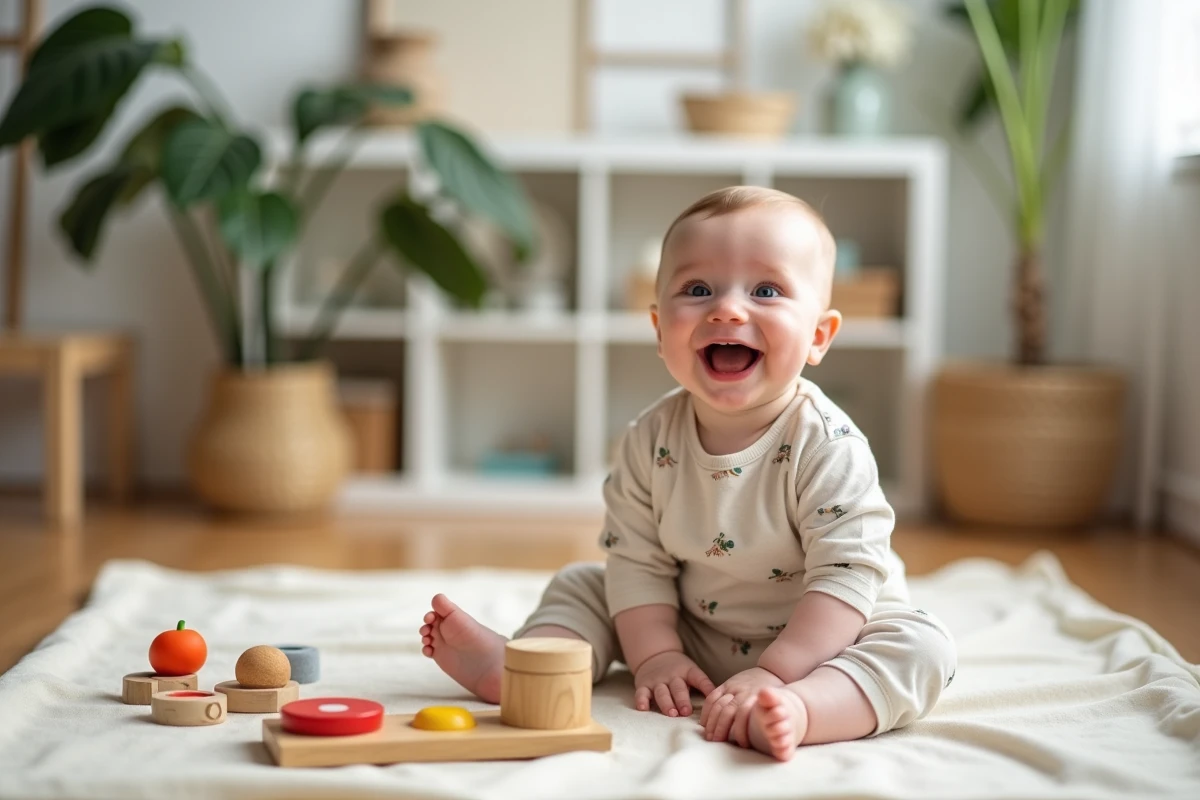
At 8 months, an infant is not lacking in stimulation: they receive it constantly. We regularly observe in consultations that parents overinvest in structured activities while motor and cognitive development primarily relies on the quality of the proposed environment. Here are ten concrete activities to stimulate a baby’s awakening at 8 months, keeping a guiding principle: offer without imposing, and observe before intervening.
1. Sensory bin with everyday objects
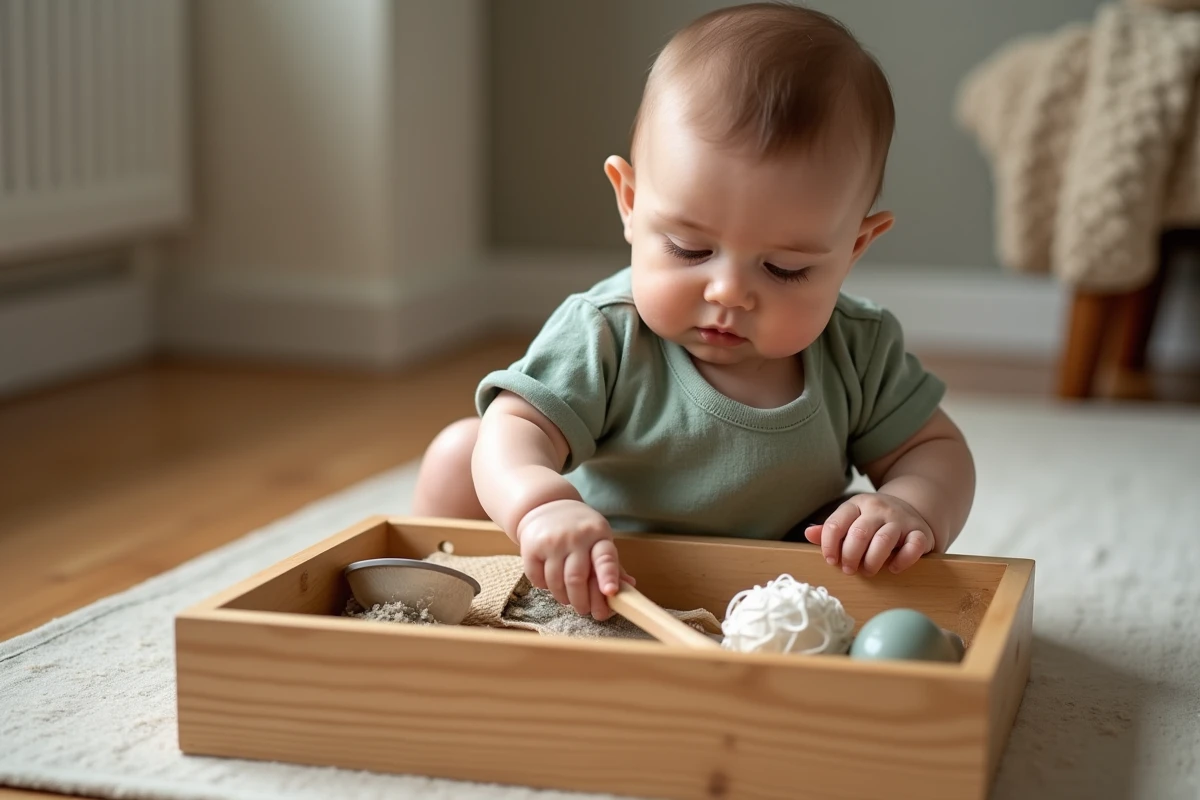
A shallow bin containing objects with varied textures (sponge, wooden spoon, crumpled fabric, cork) works on hand-eye coordination and fine motor skills. The 8-month-old infant grabs, brings to their mouth, drops, and repeats. To find more ideas to stimulate a baby’s awakening at 8 months, varying materials remains the simplest lever.
We recommend limiting the content to four or five objects at a time. Too many choices scatter attention and cause a fluttering that is not exploration, but rather sensory overstimulation.
2. Free motor exploration on the floor without thick mats

A firm floor (hardwood, tiled covered with a thin rug) provides better proprioceptive feedback than a cushioned mat. At 8 months, the transition from belly to sitting position and the first movements are built through the stable supports that the floor provides.
Clear a space of a few square meters, place one or two attractive objects at a reasonable distance, and let the baby solve the motor problem on their own: crawl, pivot, pull themselves up. The adult remains present, in the background, available without directing.
3. Object permanence game with a cloth

Around 8 months, the infant begins to understand that a hidden object continues to exist. A simple opaque cloth placed over a familiar toy is enough to engage this cognitive skill. The child lifts, discovers, and rejoices.
This game reinforces emerging working memory. Varying the hidden object and the color of the cloth prevents boredom without multiplying accessories.
4. Naming gestures and objects in context

Direct verbal interaction stimulates language development more than any sound toy. Describing what you are doing (“I am cutting the banana,” “you are grabbing the spoon”) during meals or diaper changes anchors vocabulary in immediate sensory experience.
At 8 months, the baby does not yet produce recognizable words, but they segment sound flows. The shorter and more contextualized the verbal sequences, the better they process them.
5. Repetitive gesture nursery rhymes

Gesture nursery rhymes combine melody, rhythm, and movement. They simultaneously engage hearing, motor coordination, and anticipation. An 8-month-old baby who knows “Ainsi font, font, font” begins to mimic the hand gesture before the corresponding musical passage.
We recommend a limited repertoire (three to four nursery rhymes) repeated over several weeks rather than a constant rotation. Repetition is the dominant learning mechanism at this age.
6. Transferring water during bath time

Two plastic cups and bath water are enough. Transferring mobilizes palmar grasp, bimanual coordination, and introduces the first notions of container and content.
Water play remains one of the most comprehensive sensory activities at this age, as it combines tactile, visual (reflections, splashes), and auditory stimulation. No need for sophisticated bath toys.
7. Textured board book
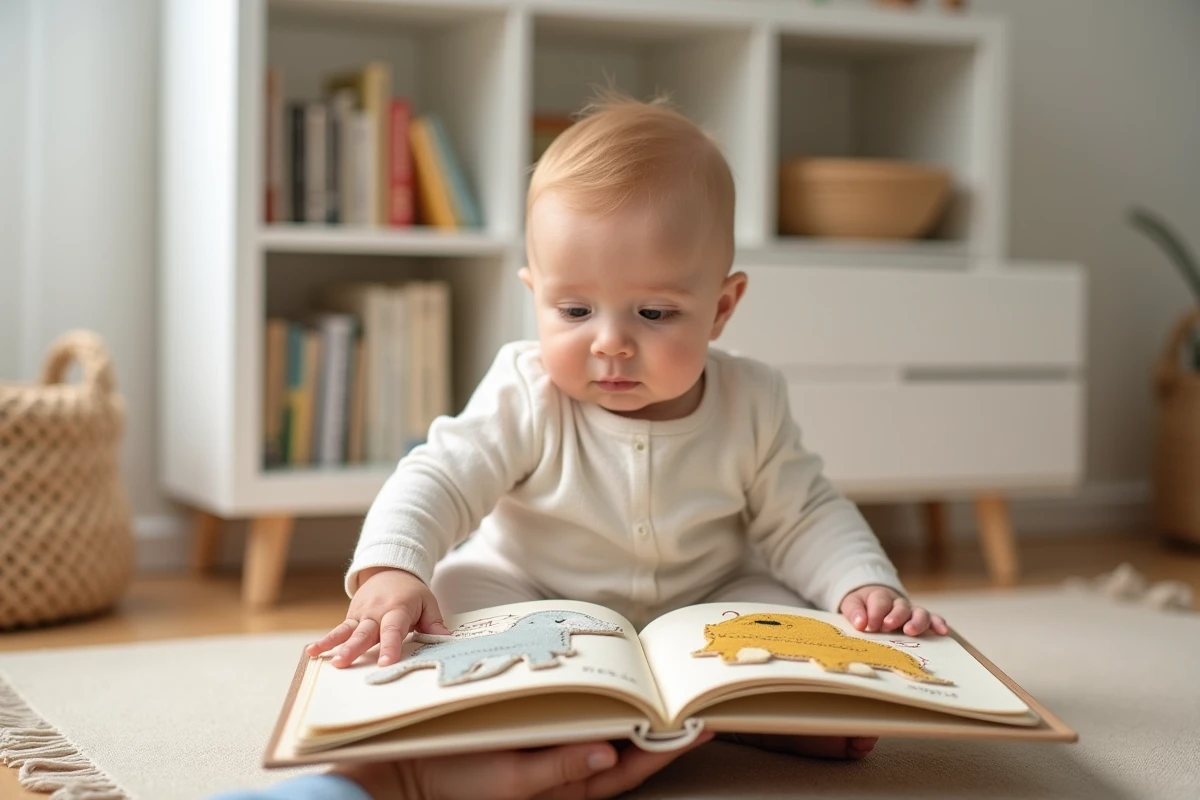
Touch books are not meant to be “read” at 8 months. They are for manipulating, turning thick pages, scratching a rough surface, lifting a flap. The activity is primarily motor and sensory.
The adult commenting on the images in short sentences adds a linguistic dimension. Exploring a single book in depth for a week is better than flipping through five books for thirty seconds each.
8. Montessori treasure basket
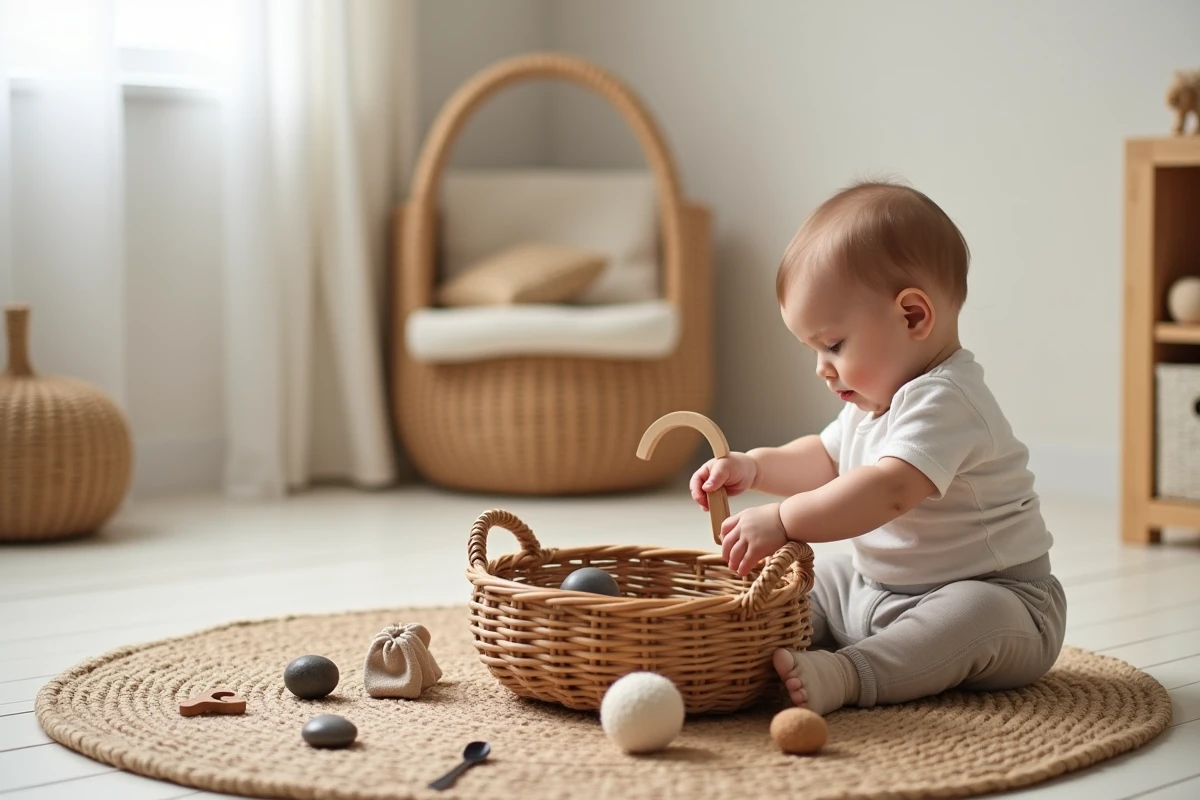
The treasure basket gathers objects made of various natural materials: wood, metal, fabric, leather, raffia. The principle is based on autonomous exploration. The child chooses, examines, and compares without adult intervention.
Criteria for selecting objects:
- Large enough not to be swallowed, but small enough to be held in one hand
- Non-toxic natural materials, without small detachable parts
- Variety of weights, temperatures to the touch, and sounds when the object falls
9. Sensory outing outdoors

Exposure to the outdoor environment (park, garden, forest) offers a sensory spectrum that no indoor setting can replicate: wind on the skin, grass under the hands, bird sounds, variations in light. Outdoor play complements awakening at 8 months with a wealth of uncontrolled stimuli.
Placing the baby on a blanket on the ground and letting them observe, touch the grass, and manipulate a leaf constitutes a complete awakening activity. Nature does not need to be scripted.
10. Simple face-to-face imitation game

At 8 months, the infant begins to reproduce simple gestures observed in adults: clapping hands, shaking their head, saying “goodbye.” These proto-imitations are the foundations of social communication.
Sitting face to face with the baby, producing a slow gesture, and waiting for their response constitutes a structuring exchange. Responding to the baby’s signals stimulates more than directing their actions.
The common thread of these ten activities can be summed up in one sentence: a suitable environment, a few well-chosen objects, and an attentive adult will always replace an accumulation of electronic toys. The development of an 8-month-old baby progresses through free exploration, not through the multiplication of stimuli.