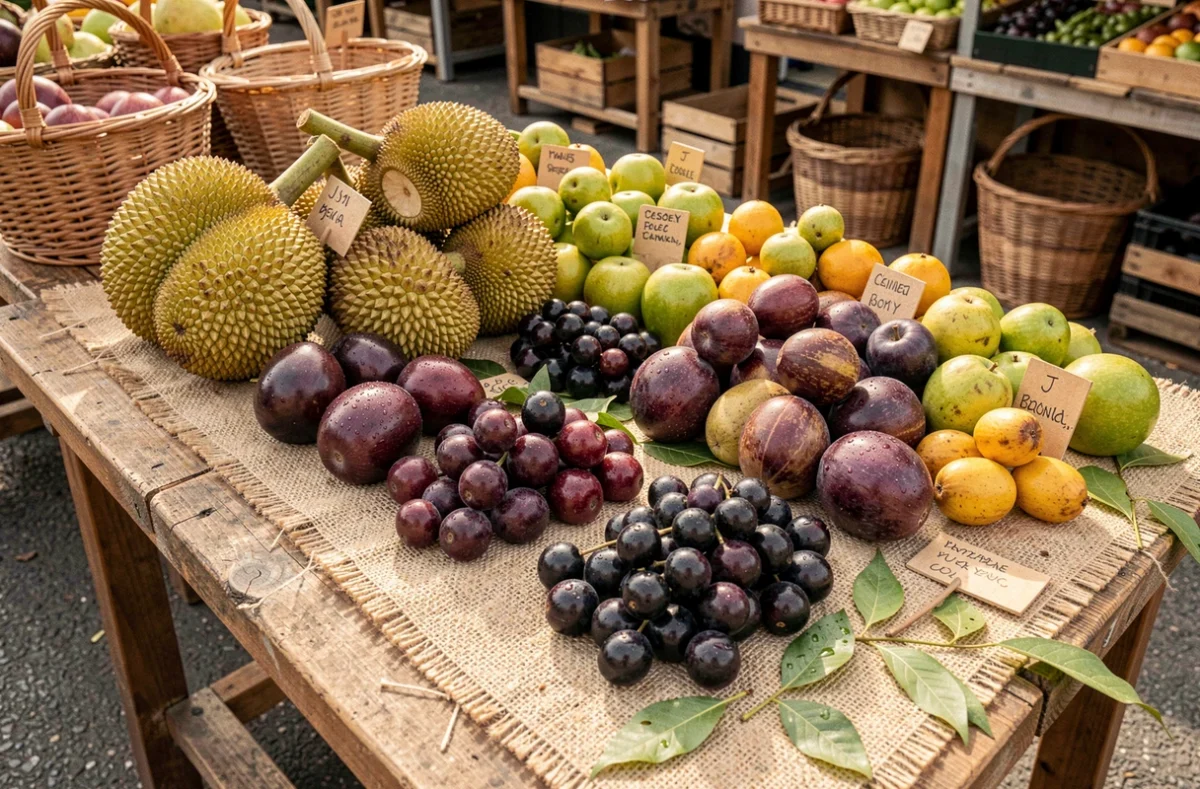
When searching for fruits that start with the letter J, most online lists are limited to four names. The jaboticaba, jackfruit, jamalac, and jujube consistently appear. By broadening the scope to include regional varieties, vernacular names, and lesser-known botanical classifications, the list significantly expands. Which J fruits truly deserve attention, and what do their botanical and nutritional differences reveal?
Comparative table of J fruits: botanical families and geographical origins
These four fruits share an initial letter, but nothing else. They belong to distinct botanical families, grow on different continents, and produce flesh with no commonality.
| Fruit | Scientific Name | Botanical Family | Origin Area | Type of Flesh |
|---|---|---|---|---|
| Jackfruit | Artocarpus heterophyllus | Moraceae | India, Bangladesh | Fibrous, sweet when ripe |
| Jujube | Ziziphus jujuba | Rhamnaceae | China | Crunchy (fresh), soft (dried) |
| Jaboticaba | Plinia cauliflora | Myrtaceae | Brazil | Gelatinous, tart |
| Jamalac | Myrtaceae | Myrtaceae | South East Asia | Watery, slightly sweet |
The jujube belongs to the Rhamnaceae family, which is distantly related to the Myrtaceae family that includes both jaboticaba and jamalac, although these two belong to different genera. The jackfruit, on the other hand, is part of the Moraceae family. This taxonomic dispersion results in differing cultivation requirements, textures, and flavor profiles that have no overlap.
The jaboticaba grows directly on the trunk of the tree, a phenomenon known as cauliflory, which is also observed in cacao trees. The jackfruit, for its part, produces the largest fruit borne by a tree. Grouping these species under the letter J is a matter of the alphabet, not botany.
Exploring fruits starting with the letter j, it is noted that names vary across French-speaking regions, complicating the inventory.
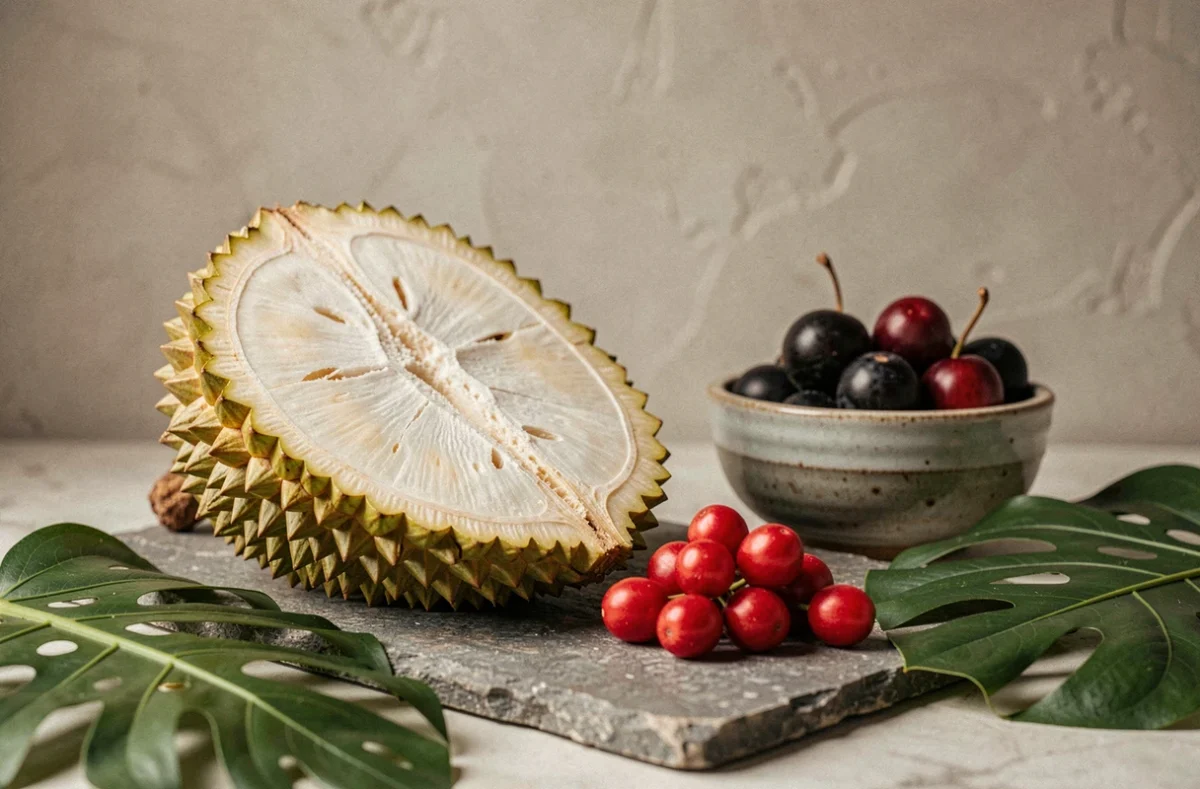
Fresh jujube vs dried jujube: two profiles for the same fruit
The same fruit, two culinary categories. The harvest stage determines everything. The fresh jujube is picked before full maturity, when the skin changes from green to yellow-red. Its crunchy and juicy flesh resembles that of an apple.
Left on the tree longer, the jujube loses its water, concentrates its sugars, and takes on a wrinkled appearance that earns it the nickname “Chinese date.” Fresh, it is eaten like a table fruit. Dried, it is used in herbal teas, soups, or confections in East Asia.
Climatic constraints of the jujube tree
A study published in September 2026 in Frontiers in Plant Science showed that winter cold and spring frosts severely limit the distribution of the jujube tree in northern China. After bud break, young shoots, flowers, and fruits become particularly vulnerable. This sensitivity explains the confinement of the jujube tree to warm temperate zones and its absence from higher latitudes.
Jackfruit and jamalac: culinary uses at opposite ends
Both grow in the tropics. However, their use in cooking is not comparable.
- The immature jackfruit has a fibrous and neutral flesh that absorbs spices and sauces. It serves as a substitute for pulled meat in plant-based cooking, in curries or tacos.
- The ripe jackfruit develops an intense sweet aroma, reminiscent of a pineapple-mango blend, and is consumed raw or as a dessert.
- The jamalac (or Java apple) offers very watery flesh, almost without a marked flavor, used to quench thirst or add crunch to tropical salads.
The jackfruit transitions from a cooking vegetable to a dessert fruit depending on its ripeness. This dual use is rare in the fruit world. The jamalac, on the other hand, remains limited to fresh consumption, with no notable culinary versatility.

Beyond the four classics: lesser-known J fruits
French-speaking inventories almost always stop at four names. Other fruits have names starting with J in certain regions or languages close to French. The jambose, a cousin of the jamalac, is one of these discreet varieties found in French-speaking tropical areas.
Their absence from international trade explains their obscurity. Their presence in botanical nomenclatures shows that the letter J encompasses more fruit diversity than is suggested by usual lists.
Why so few J fruits in French
The reason is phonetic. The French “j” sound (fricative consonant) does not correspond to the opening sounds of fruit names in the languages of origin, whether it be Tupi-Guarani, Mandarin, or Malay. The names have been Frenchified from colonial or commercial transcriptions, and only a few have retained an initial J.
The letter J is one of the least represented in French fruit nomenclature, alongside K and W. Each J fruit bears the mark of a distinct linguistic journey, making the alphabetical category all the more artificial.