The EAT8 automatic gearbox, manufactured by Aisin for the Stellantis group, is equipped in the majority of recent Peugeots: 308, 3008, 508, and 5008. This eight-speed transmission with a torque converter is officially presented as not requiring any fluid changes.
However, Aisin recommends replacing the fluid between 60,000 and 80,000 km. This discrepancy between the position of the car manufacturer and that of the transmission manufacturer is the starting point for any reflection on the maintenance of this gearbox.
EAT8 and e-EAT8: two variants not to be confused
Not all EAT8 gearboxes are identical. The standard thermal version and the plug-in hybrid version (e-EAT8) differ in their internal architecture, electronic management, and the torque they can handle. The e-EAT8 integrates an electric motor directly into the gearbox casing, which alters the thermal and mechanical stresses on the fluid.
This distinction has a direct consequence on maintenance: the oil reference, the necessary volume, and the filling procedure may not be the same. Before any intervention, accurately identifying the variant of the gearbox (via the registration document or engine label) avoids ending up with unsuitable fluid.
To delve deeper into the subject, a detailed guide on maintenance and fluid change of the Peugeot EAT8 gearbox lists the schedules and average prices according to configurations.
Diagnosis before fluid change: a step often neglected by workshops
Jolts during gear shifts, hesitation when starting cold, or slight slipping during acceleration are symptoms commonly attributed to used oil. This simplistic interpretation sometimes leads to draining a gearbox whose real problem lies elsewhere.
A faulty sensor, a stuck solenoid, or a hydraulic pressure issue produce exactly the same symptoms as degraded oil. Reading the fault codes via the OBD port is therefore a distinct preliminary step from the periodic fluid change. A workshop that directly offers a fluid change without electronic diagnosis skips half the work.
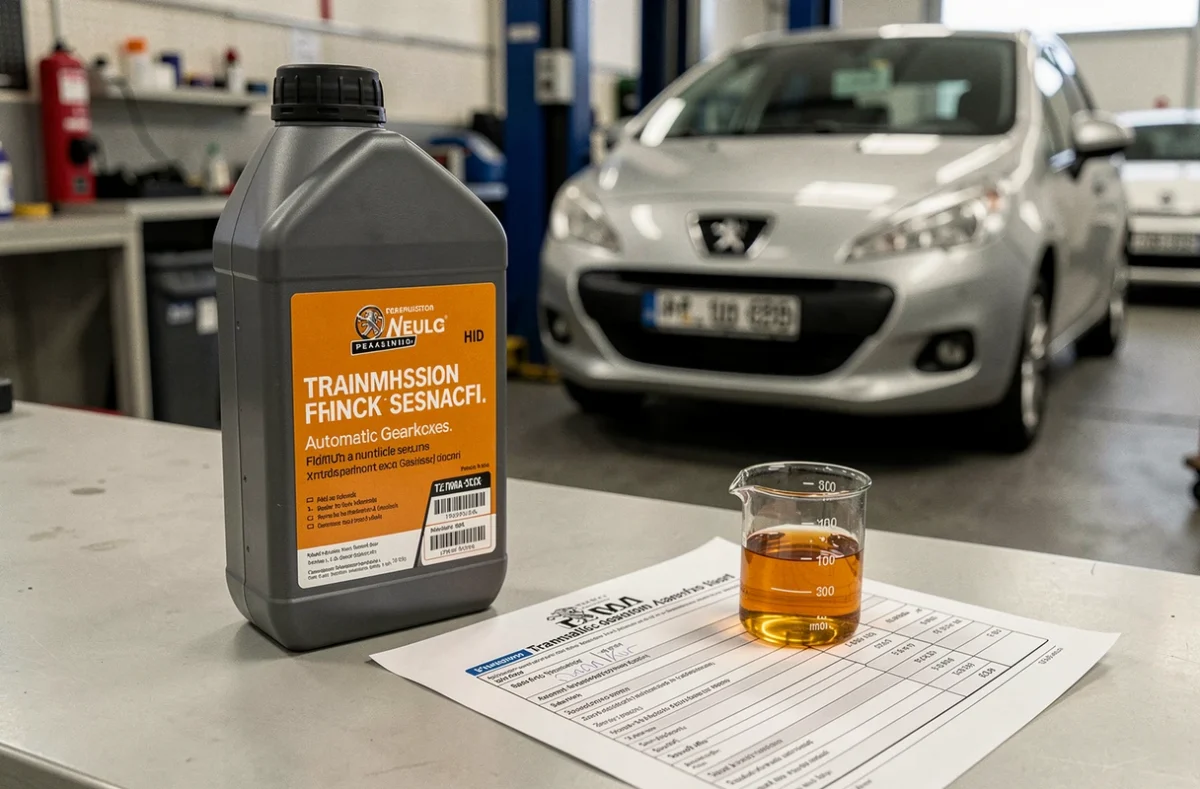
It is also necessary to check if a software update is available for the gearbox control unit. Peugeot regularly publishes patches that modify gear shift mappings. A behavioral issue may disappear with a simple reprogramming, without touching the fluid.
When a fluid change is truly justified
In the absence of fault codes and after a software update, a fluid change remains relevant in two cases: the mileage has exceeded the range recommended by Aisin (60,000 to 80,000 km), or the usage conditions are severe. Urban driving with short trips, frequent towing, and mountain driving accelerate the degradation of the ATF fluid.
- Short and repeated urban trips: the oil does not reach its appropriate temperature, leading to the accumulation of condensates that dilute the additives
- Towing or heavy load: the torque converter works harder, generating more heat and metallic particles
- Plug-in hybrid frequently in electric mode: the gearbox undergoes irregular thermal cycles that differently stress the fluid
Static or dynamic fluid change: the choice that changes everything
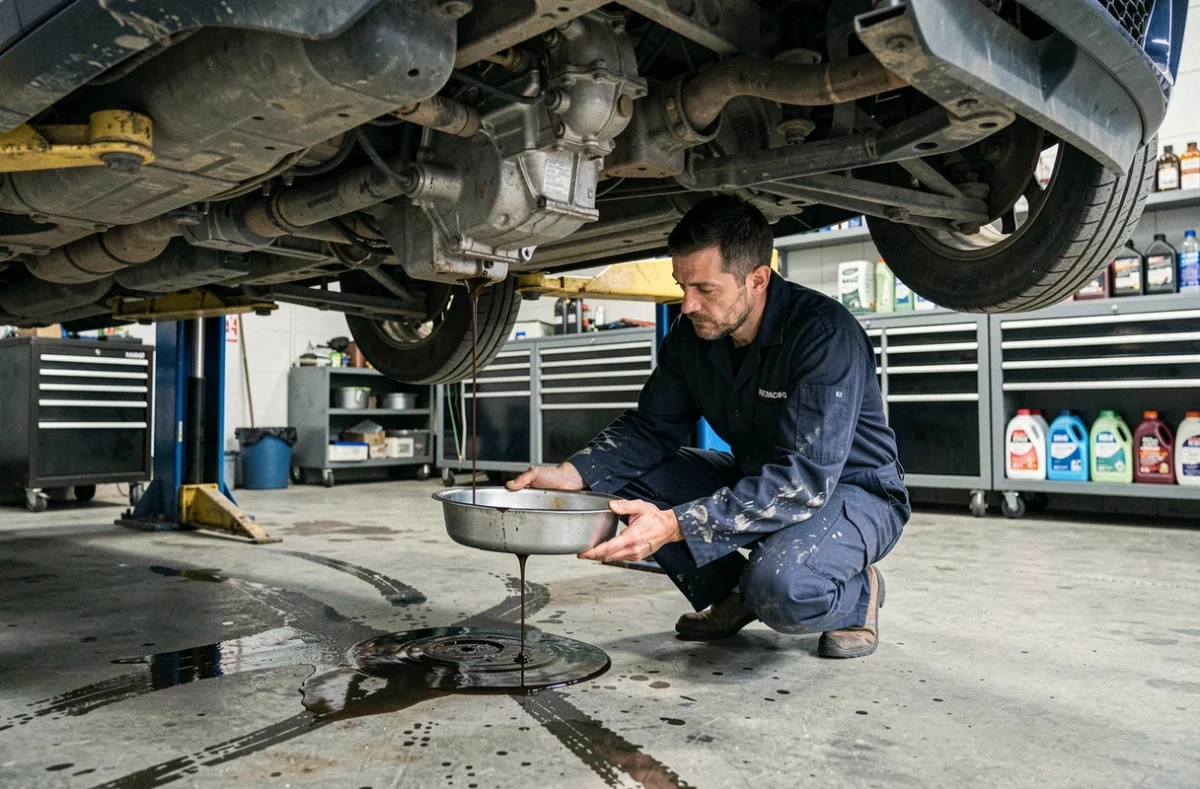
Gravity draining (known as static) involves opening the drain plug and letting the oil flow out. This method only replaces a fraction of the total volume, as a significant portion of the fluid remains trapped in the torque converter and internal piping.
The dynamic fluid change, performed with a dedicated machine, replaces almost all of the fluid. The machine injects new oil while the engine runs, pushing the used oil out of the circuit. The result is incomparable in terms of cleanliness of the hydraulic circuit.
Impact on pricing
The price of an EAT8 fluid change varies significantly depending on the chosen method and the parts replaced. Observed prices range from 290 to 950 euros depending on the type of intervention, whether or not the filter and casing are replaced, and the volume of oil used.
- Simple static fluid change: the cheapest, but also the least effective in the long term
- Dynamic fluid change without filter replacement: a good compromise for regular maintenance
- Dynamic fluid change with new filter and casing: the most comprehensive intervention, recommended beyond 100,000 km or in case of a late first maintenance
- Cost of the oil alone: the approved ATF fluid represents a significant portion of the quote, as the gearbox requires several liters of specific lubricant
Level check and filling procedure for the EAT8 gearbox
Filling an EAT8 gearbox is not just about pouring the right amount of oil. The level must be checked at a precise fluid temperature, measured via the diagnostic tool. A deviation of a few degrees skews the reading and can lead to underfilling or overfilling.
Overfilling increases internal pressure, causes foaming in the fluid, and disrupts the operation of the solenoids. Underfilling, on the other hand, generates insufficient lubrication and accelerates wear of internal components. Both errors lead to the same result: degraded gear shifts and, ultimately, mechanical damage.

After filling, a reset of the gearbox control unit is generally necessary. This step allows the system to adjust its pressure and synchronization parameters to the properties of the new fluid. Without this reset, the gearbox continues to operate with the corrections calculated for the used oil, which can maintain abnormal behaviors despite the fluid change.
The EAT8 gearbox remains a reliable transmission when its maintenance follows Aisin’s recommendations rather than the “lifetime oil” mention in the manufacturer’s booklet. The most underestimated point remains the filling procedure: a correct fluid poured without temperature control or electronic reset does not yield better results than properly dosed used oil.