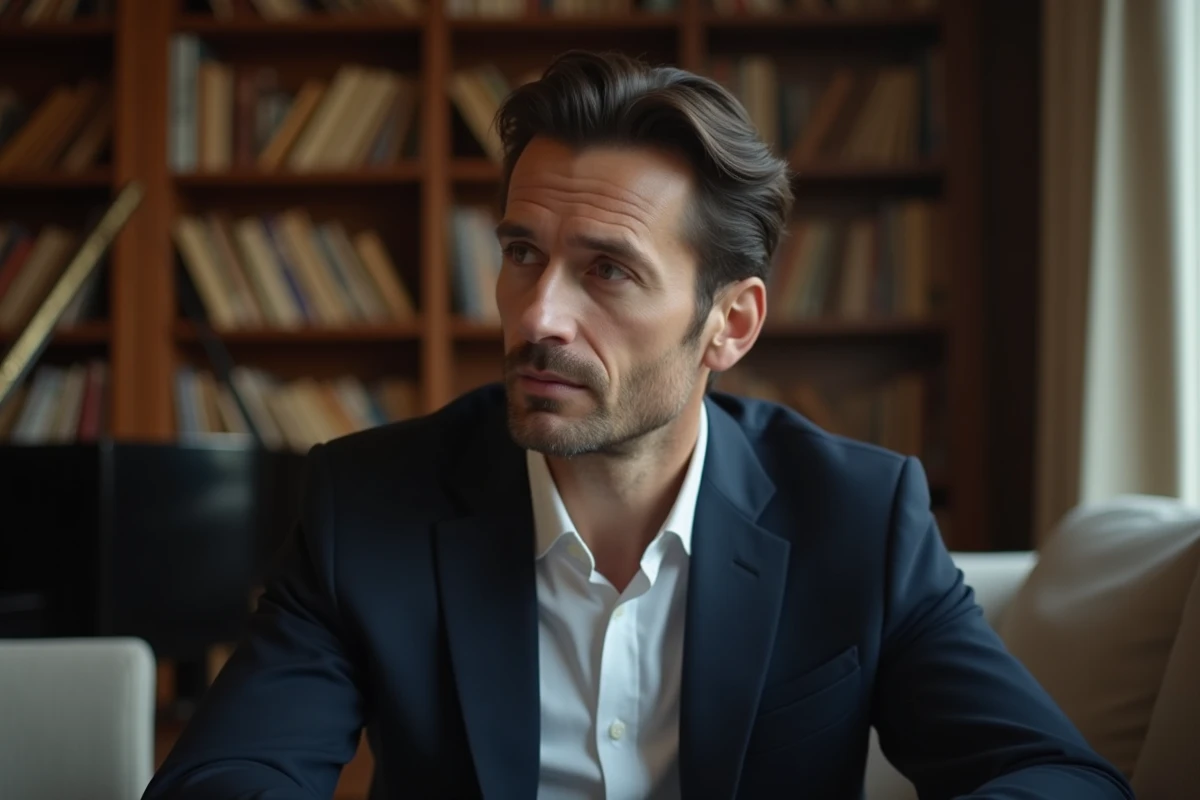
Philippe Jaroussky occupies a unique place in the French musical landscape. A countertenor recognized on the greatest international opera stages, he has built a career of over two decades in the baroque repertoire and beyond. His private life, on the other hand, remains a territory he protects with an uncommon determination in the artistic community.
Philippe Jaroussky and Hiba Tawaji: a couple between two musical shores
Since the mid-2010s, Philippe Jaroussky has been sharing his life with Lebanese-French singer Hiba Tawaji. Their joint public appearances and several interviews focused on shared artistic projects have gradually confirmed this relationship, without the countertenor ever staging it dramatically.
The couple represents a rather rare case in the lyrical and crossover world: a Franco-Arab duo regularly associated with intercultural dialogue initiatives. Concerts and joint projects between France and Lebanon, particularly at the Arab World Institute, have marked their journey in recent years. An article detailing Philippe Jaroussky’s private life and his partner allows us to trace the known stages of this relationship.
What is striking is that the Francophone cultural press most often treats their careers separately. Portraits dedicated to Jaroussky focus on his voice and repertoire, while those dedicated to Tawaji focus on her Lebanese journey. Their shared private life as a driving force for common artistic projects remains a little-explored angle.

Countertenor and private life: why Jaroussky cultivates discretion
Jaroussky’s public stances on the protection of artists’ privacy have been affirmed since the creation of his Musical Academy in 2017. In several recent interviews, he emphasizes the need to protect young singers from hyper-media exposure and intrusions into their personal lives.
This stance is not merely a defensive reflex. It is part of a broader reflection on the condition of the lyrical artist in the 21st century, where social media and tabloid press exert increasing pressure. Jaroussky explicitly separates the public artist from the private individual, a boundary that few French classical musicians draw as clearly.
The concrete result: online searches about his private life mostly lead to speculative content or compilations of fragmented information. The available data do not allow for a complete picture of his off-stage daily life, and that is precisely what he seeks.
The countertenor’s voice and the question of public image in France
The public’s curiosity about Jaroussky’s private life is not unrelated to the very nature of his voice. The countertenor, who sings in a head voice range close to that of a mezzo-soprano, has always sparked questions that go beyond the musical framework.
In his book of interviews with journalist Vincent Agrech, published in 2019, Jaroussky provides a technical clarification often repeated: the difference between countertenor and haute-contre does not lie in the range but in the singing technique. A haute-contre is a tenor whose voice naturally reaches the high notes, while the countertenor deliberately uses the head voice, also known as falsetto, as the primary mode of vocal emission.
- The baroque repertoire (Handel, Vivaldi, Cavalli) remains Jaroussky’s preferred terrain, with roles originally written for castrati
- His exploration of French melody and sacred repertoire has broadened his palette well beyond opera
- Collaborations with contemporary composers, such as Kaija Saariaho for Only the Sound Remains at the Opéra de Paris, testify to a constant aesthetic openness
This diversity of repertoire contrasts with the persistent public curiosity about his intimate sphere, as if the uniqueness of the voice called for an explanation that transcends music.
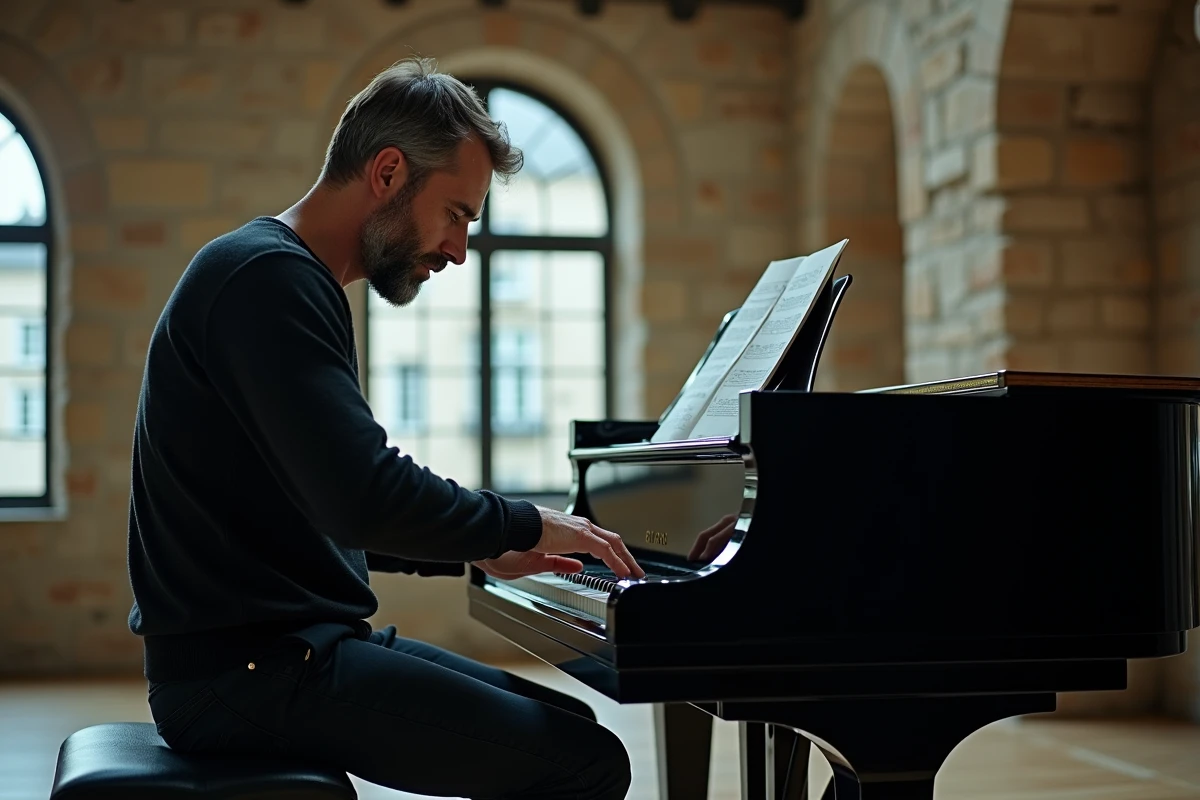
Jaroussky Academy and transmission: the other commitment of the French countertenor
The creation of the Philippe Jaroussky Musical Academy, located at La Seine Musicale, represents a turning point in his trajectory. The project aims to train young musicians from backgrounds far removed from classical music, with a particular emphasis on human as well as technical support.
Jaroussky takes on a role as a teacher and mentor that extends his reflection on the protection of emerging artists. The young singers he mentors benefit from an environment where stage performance is not dissociated from personal balance. The Academy embodies his vision of a sustainable musical career, counter to the logics of overexposure.
This project also has an intercultural dimension. The journey of his partner Hiba Tawaji, a Lebanese artist navigating between Eastern music and Western classical repertoire, visibly feeds this sensitivity. Field feedback varies on the extent to which their relationship has directly influenced the philosophy of the Academy, but the timeline of Jaroussky’s engagements in cultural dialogue coincides with the period when their couple became more visible.
Private life of lyrical artists: a debate that goes beyond Jaroussky
The question of media exposure for opera and classical music singers takes on a new dimension in the age of social media. Lyrical artists, long protected by the relative confidentiality of their field, face an increasing demand for personal transparency.
Philippe Jaroussky is not the only one resisting this trend, but his notoriety in France, amplified by numerous television appearances and an abundant discography, places him at the forefront. His communication strategy rigorously separates music and intimacy, without ever falling into calculated mystery.
The paradox remains intact: the more an artist protects their private life, the more the public’s curiosity intensifies. Searches linking Jaroussky’s name to terms like “partner,” “married,” or “private life” rank among the most frequent queries concerning him. This dynamic, far from harming his career, seems to enhance the aura of a musician whose voice alone is enough to occupy public space.